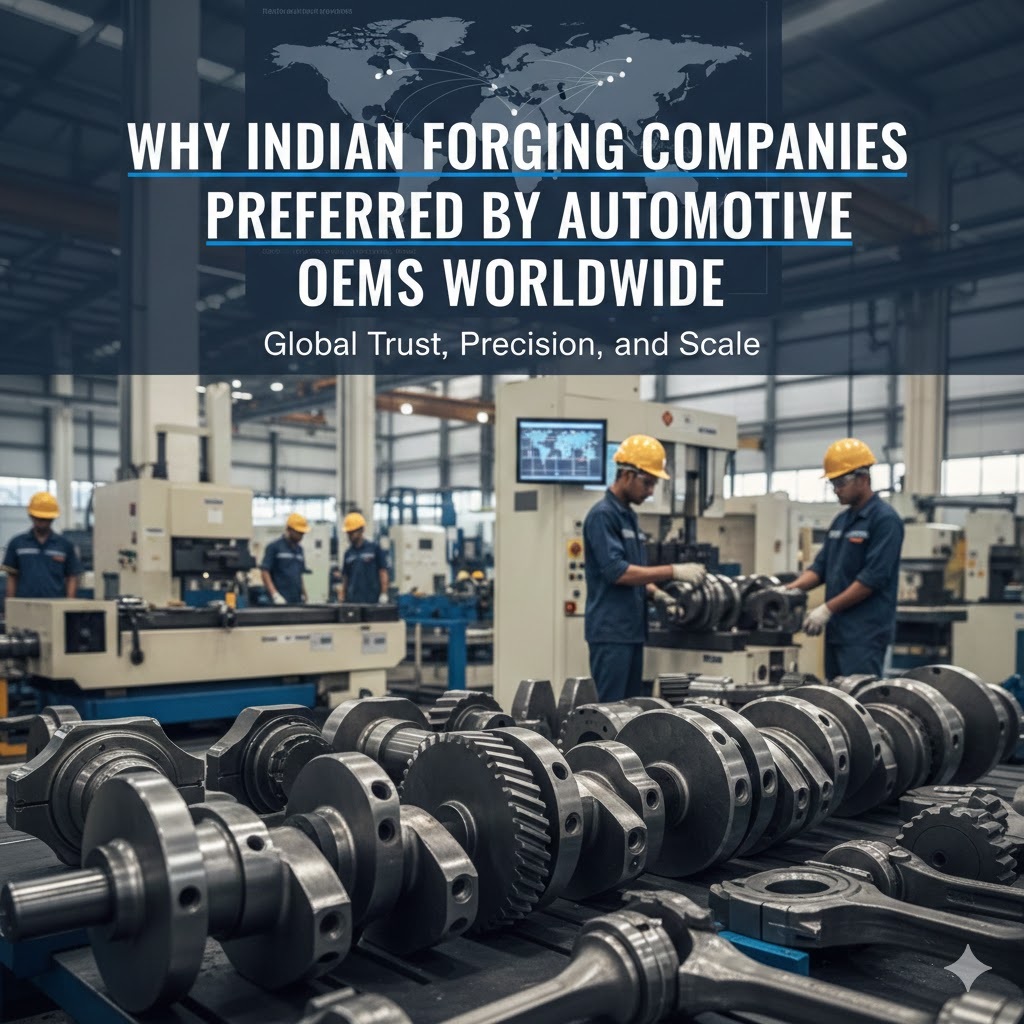
Automotive OEMs do not reward noise. They reward predictability under pressure. In a supply chain where one microscopic defect can shut down an assembly line, preference is earned only through years of silent execution. Indian forging companies sit in this position today not because of sentiment, geography, or cost slogans—but because global OEMs have tested them under volume, audit, fatigue cycles, and failure analysis. The outcome of those tests explains the preference.
Forging Is Where Theory Ends and Reality Begins
Forging is not an academic process. It is where material science meets brute force, thermal instability, tool wear, and cycle-time tyranny. Every forged automotive component carries the memory of how it was formed—temperature gradients, deformation rate, grain flow direction, die condition, and post-forge treatment. OEMs gravitate toward suppliers who understand this memory and control it.
Indian forging operations grew inside high-volume, failure-intolerant environments. This shaped a culture where process discipline matters more than presentation. That culture is the foundation behind the global trust placed in forging manufacturer India suppliers.
Cost Efficiency Built on Yield, Not Wages
The global misconception is that India’s advantage begins and ends with labor. In forging, labor is not the dominant cost driver—yield loss is. Scrap rates, die life, reheating losses, machining allowance excess, and energy consumption decide profitability.
Indian forging plants learned early to survive on tight margins. That survival bred ruthless efficiency. Dies are designed to last. Flash volumes are minimized. Heating cycles are optimized. Machining stock is engineered, not guessed. OEMs recognize this immediately when cost-down initiatives do not degrade fatigue life or dimensional stability.
This is why forging manufacturer India partnerships persist even when freight costs fluctuate or currencies move.
Metallurgy Treated as a Process Variable, not a Certificate
Automotive forgings fail for metallurgical reasons long before they fail dimensionally. Inclusion morphology, carbide distribution, decarburization depth, and heat treatment uniformity dictate real-world performance.
Indian forging companies internalized metallurgical control instead of outsourcing it. In-house laboratories, controlled heat treatment lines, and batch-level traceability are operational necessities, not audit theater. OEM validation teams value this because it reduces unknowns. Fewer unknowns mean fewer surprises in endurance testing and field performance.
Scale Without Chaos
Global vehicle platforms demand consistency at scale. A component produced in January must behave identically to the same component produced in October. This is where many suppliers fail.
Indian forging facilities operate some of the densest forging capacities globally. High-tonnage presses, automated billet handling, controlled lubrication systems, and inline inspection are deployed not to impress visitors but to stabilize output. Scale is treated as a control problem, not a volume problem.
OEMs sourcing from a forging manufacturer India gain the confidence that ramp-ups will not dilute process integrity.
Engineering That Starts Before the Drawing Freezes
OEMs no longer want suppliers who wait for finalized drawings. They want contributors who understand load paths, fatigue initiation zones, and manufacturability trade-offs.
Indian forging engineers increasingly engage upstream—refining radii to improve grain flow, suggesting material substitutions that preserve strength while reducing cost, and redesigning sections to eliminate unnecessary machining. These inputs reduce total system cost, not just part price.
This capability separates vendors from partners.
Audit Survival Is Not Optional
OEM audits are relentless. Process audits, product audits, layered audits, and unannounced visits are routine. Indian forging companies that export consistently have adapted to live under this microscope permanently.
Process capability indices, control charts, corrective action discipline, and traceability down to heat and billet level are daily practices. This operational maturity explains why forging manufacturer India suppliers often retain programs across multiple vehicle generations.
Real Example of Execution Discipline: Sendura Forge Pvt. Ltd
Sendura Forge Pvt. Ltd represents the execution-focused profile OEMs seek. Precision forging, controlled workflows, and repeatability-driven operations define its positioning. The emphasis remains on delivering consistent mechanical performance under production conditions rather than marketing abstractions. This operational seriousness aligns with OEM expectations across automotive and industrial segments.
Supply Chain Density as a Strategic Advantage
Forging does not operate in isolation. Tooling, heat treatment, machining, testing, and logistics must synchronize. Indian forging hubs evolved as dense industrial ecosystems where these dependencies sit within reachable distance.
This density reduces lead times, simplifies corrective action cycles, and strengthens contingency planning. During global disruptions, OEMs observed that Indian suppliers recovered faster—not because of heroics, but because of proximity and integration.
Adaptation to New Powertrain Realities
Electrification has not eliminated forging. It has redirected it. Structural components, driveline elements, and safety-critical parts still rely on forged strength and fatigue resistance.
Indian forging companies are adapting with aluminum forging, advanced alloy development, and tighter dimensional control suited for emerging platforms. OEMs prefer suppliers who adapt early rather than retrofit capability later.
This future alignment reinforces long-term sourcing confidence.
Why Preference Becomes Policy
OEM preference is not emotional. It is statistical. Warranty data, field failures, audit scores, delivery performance, and cost stability accumulate over time. Indian forging companies score well across these metrics because their systems were built under constraint, not abundance.
That is why forging manufacturer India suppliers are written into sourcing strategies, not just RFQs.
What Automotive OEMs Actually Evaluate Before Approving a Forging Supplier
OEM approval is not based on brochures or sample parts. It is earned through a layered evaluation that tests how a supplier behaves when things go wrong, not when everything goes right. Indian forging companies that reach global OEM status do so by surviving this evaluation repeatedly across programs and years.
The table below reflects the real parameters OEMs scrutinize during sourcing, audits, and long-term production—not theoretical checklists, but lived decision criteria that directly influence sourcing continuity.
| OEM Evaluation Area | What OEMs Look for in Practice | Why Indian Forging Companies Perform Strongly |
| Process Stability | Consistent output across shifts, batches, and demand swings | High-volume exposure forces disciplined process control |
| Metallurgical Predictability | Repeatable grain flow, hardness, and fatigue behavior | In-house heat treatment and lab validation reduce variability |
| Tooling & Die Management | Controlled wear, predictable die life, minimal flash variation | Die design optimized for longevity, not short-term output |
| Response to Non-Conformance | Speed, root-cause depth, and permanence of corrective action | Continuous audit exposure builds corrective discipline |
| Cost-Down Capability | Cost reduction without weakening component performance | Yield-focused engineering replaces cost cutting |
| Engineering Collaboration | Early-stage input that improves manufacturability | Application engineering integrated with production |
| Supply Continuity | Ability to deliver during disruptions | Dense local ecosystems reduce dependency risk |
OEMs do not expect perfection. They expect control. Indian forging suppliers that understand this distinction remain approved long after initial contracts are signed.
Conclusion
Global automotive OEMs prefer Indian forging companies because they perform where it matters most—inside the process, under load, at scale, and over time. Cost efficiency without compromise, metallurgical discipline, scalable consistency, and engineering collaboration define this preference. In an industry that punishes weakness instantly, Indian forging has proven resilient, adaptive, and quietly formidable.