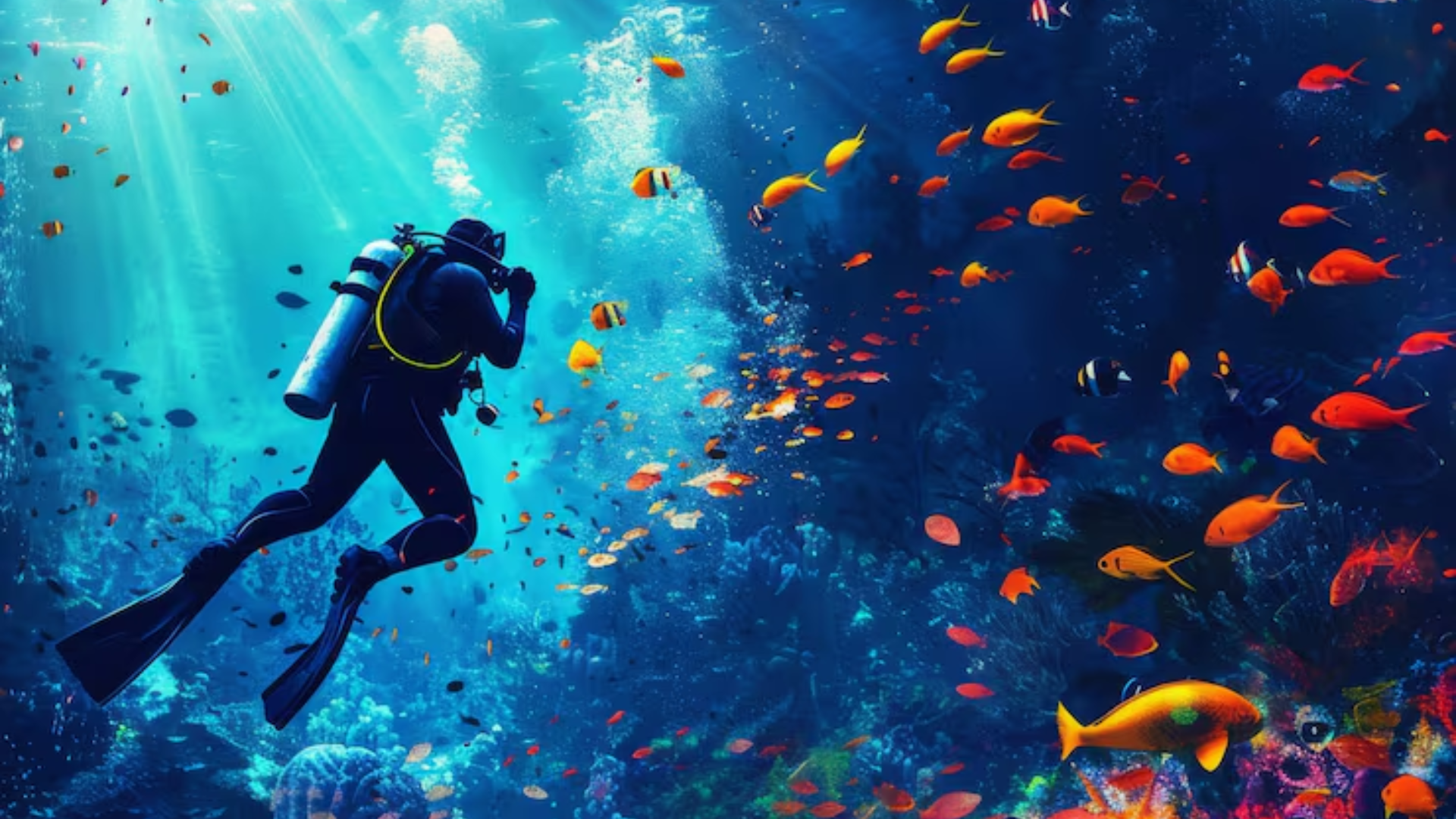
There is a whole new world under the water. It is a world with a different ecosystem than the one we see on land. The underwater world is home to beautiful reefs, a variety of fish, turtles, whales, and much more.
Sadly, less than 1% of the world’s population is PADI (Professional Association of Diving Instructors) certified. It means 99% of the world’s population is unfamiliar with the beauty beneath the oceans.
Yet you are different. You dream of or already have glimpsed that underwater magic. And now, you are ready to go deeper, not just as a diver but as a ‘Divemaster’ who leads others into the ocean and protects it.
That shift from explorer to guardian is powerful. But it also comes with real questions that stop most people in their tracks:
- How to become a dive master?
- What is the best place for a dive master training?
- What are the requirements to be a dive master?
The fastest way to remove all the confusion is to follow our guide to a divemaster course in Koh Tao. Here we will share the prerequisites, training steps, costs, and everything you need to become a Divemaster confidently.
Stay tuned.
What Are The Prerequisites To Be A Dive Master?
All PADI Divemaster programs follow a similar structure, no matter where you are training in the world. The requirements include:
- Age: 18+
- Certifications: Advanced + Rescue (or equivalent)
- First aid/CPR: within the last 24 months
- Deep 40 and Nitrox specialties must be completed
- Medical clearance: signed within the last 12 months
- Logged dives: 40 to start, 60 to certify
How To Become A Dive Master: Step-by-Step Guide
Step 1: Get Diving Experience
The first thing you need to be a Divemaster is diving experience. This doesn’t mean you just need to know how to ascend or descend, but that you can handle different kinds of underwater situations.
As an aspirant Divemaster, make sure to do different kinds of dives. Do the dives with different kinds of entry types, currents, depths, and navigations. Go for the dives where you and your buddy plan the route and execute it cleanly.
Divemaster training will challenge you to meet the demonstration quality control and the high standards. The more you dive, the more confident you feel in underwater problem management.
Step 2: Get Your Foundational Skills To “Demo Level”
As a divemaster, you need to dive so clearly that others can learn from you. This means you can perform the fundamentals (tightening buoyancy, trim, finning, mask skills) without drifting, silting, or losing track of your team.
Regular diving builds muscle memory of the fundamentals and helps you perform them on autopilot as you navigate your team underwater.
Step 3: Finish Every Dive Theory As Practical Knowledge
Each dive is a lesson if you take it as one.
All the times when you lost your way back, faced buoyancy swings, and dealt with equipment issues need to be documented. Write the following things:
- What was the issue
- How did you feel at that time
- What helped you get out of the situations
- Any notes for your future dives
When you become an instructor, this will help you understand your teammates better and be prepared for different kinds of situations.
Step 4: Pass Stamina And Watermanship Evaluations
Most programs include timed swims, snorkel swims, tired-diver tow/push, and treading water. These are a reality check that you can stay effective even when you’re tired, because leadership underwater often starts when someone else is stressed. Train a little before you start. Consistent short swim sessions beat last-minute panic training.
| Follow-up question: How deep can Divemasters dive?
Divemasters can dive to 40 meters (130 feet) in recreational diving, but your actual depth depends on three factors: your training level, local regulations, and whether you’re within no-decompression limits. Without advanced certifications, you’re capped at 40 meters. With deep diving training, you can go deeper—but that requires additional certification. |
Step 5: Learn Leadership By Assisting Real Courses
Confidence comes from repetition, not reading!
This is the heart of dive master training. You assist in actual sessions (Open Water, Advanced, Rescue), watch how divers behave under pressure, and practice controlling a group without sounding bossy or vague.
A strong program will give you repeated reps at briefings, debriefings, and underwater supervision. You will learn through a course that has:
- Theory lessons
- Pool sessions
- Ocean diving
Conclusion
Divemaster becomes achievable when you stop treating it like a single course and start treating it like a sequence: prerequisites first, then dive variety, then demo-level control, then leadership reps, then assessments.
If you build your dives with intention and choose a program that gives you repeated real-world assisting opportunities. Divemaster training in Koh Tao is popular because it’s a high-volume training hub with active dive communities and lots of opportunities to assist courses. That intensity can be excellent if you learn best through immersion and repetition.
Explore the dive master courses in Koh Tao now!